



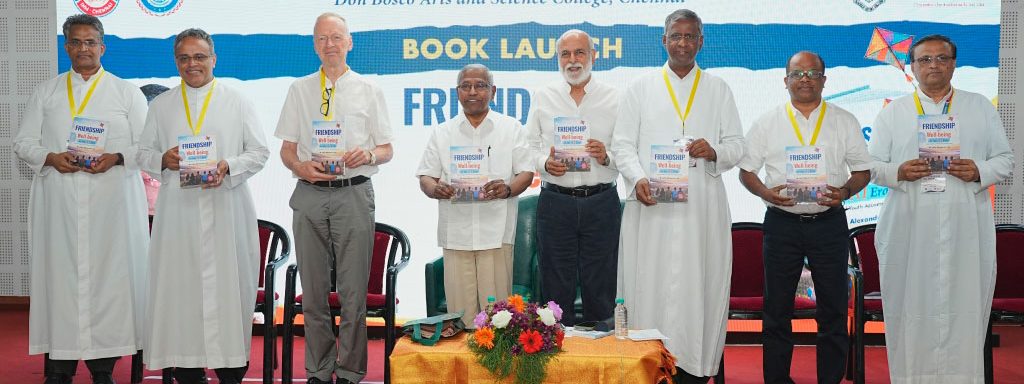
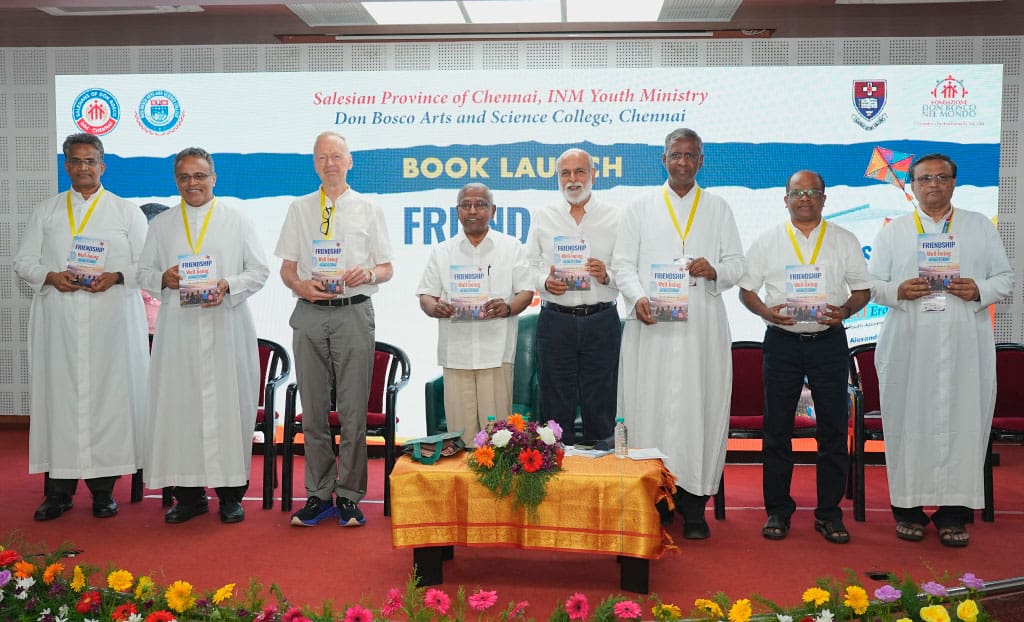
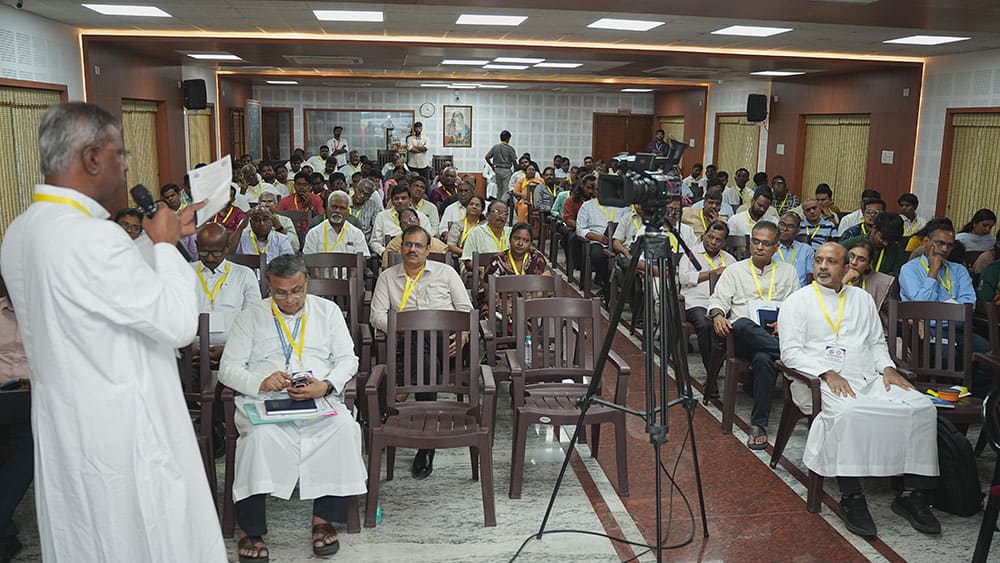
(ANS – Chennai) – Can a generation be the most connected in history and also among the loneliest? That question anchored a national research seminar in Chennai, where the Salesian Province of Chennai and Don Bosco College, Chennai, gathered more than 250 participants — Youth Ministry delegates, social scientists, educationists, researchers and young people from across India — to mark the release of a landmark study on friendship and well-being in the AI age.
The seminar launched the new book Friendship as Well-being in the AI Era: New Models of Youth Accompaniment by Fr M. John Alexander SDB (Kristu Jyoti Publications, Bengaluru). The study, also carried out thanks to the support of the DON BOSCO NEL MONDO Foundation, draws on the voices of 4,527 young people across twenty-four Indian states (through surveys, focus groups and interviews) and it is among the largest studies of youth friendship in the country. Its method is its message: rather than delivering a verdict on the young, it listens to them.
What the young reveal is a striking paradox. While 88.5% say friendship is essential to their well-being, 76.8% admit to feeling lonely even when surrounded by friends, a gap explained not by a shortage of friends but by a shortage of depth. With 84.7% using AI tools such as ChatGPT, and a third turning to them during friendship problems, the study calls for relational discernment: helping the young distinguish the simulation of friendship from the real thing, the danger Pope Leo XIV names in his encyclical Magnifica Humanitas.
In his Foreword, the Rector Major, Fr Fabio Attard SDB, calls it “a timely and significant book for our times, because it brings together careful research, human insight, educational wisdom and a deep sensitivity to the real questions young people are asking today.” He commends the way it offers a fresh reading of Don Bosco’s Preventive System — “recovered and renewed for the age of artificial intelligence” — restoring the amorevolezza of the Valdocco courtyard to the digital world where the young now live.
At the seminar, held on 01 July 2026, the inaugural address was delivered by Fr Biju Michael SDB, General Councillor for South Asia, and the keynote by the Provincial of Chennai, Fr L. Don Bosco SDB. Panel discussions explored the friendship dynamics the study surfaces: the loneliness that hides behind constant connection, “hybrid” friendships lived both online and face to face, betrayal and forgiveness, and friendships that cross the barriers of caste, religion, language and gender. Notably, 82% of respondents said such barriers do not restrict their friendships, a finding the author calls “a small but significant act of democracy.”
The book was released by Fr John Felix Raj SJ, Vice-Chancellor of St Xavier’s University, Kolkata, with the first copy presented to Antoon Vandevelde, Professor Emeritus of the University of Leuven, Belgium. Among the book’s endorsements, Br Jean Paul Muller SDB, Mission Procurator of Don Bosco Bonn, writes that “it was about time such a book was written,” adding that only if we use machines “for the well-being of humans” rather than becoming dependent on them “will we retain the strength, time and confidence to continue to interact as human beings.”
The seminar’s central proposal is captured in the book’s model of “accompaniment as friendship”: the adults who walk with the young most fruitfully are those who relate to them with the qualities of a good friend — patience, presence, honesty, respect and the freedom to let another grow. It is an invitation to exchange control for trusted presence. In this spirit, Salesian institutions are being invited to build “friendship education” intentionally into their schools, colleges, oratories and Youth at Risk centres, a deliberate counterweight to an all-pervading digital and AI culture.
Source: ANS – “Agenzia iNfo Salesiana”