



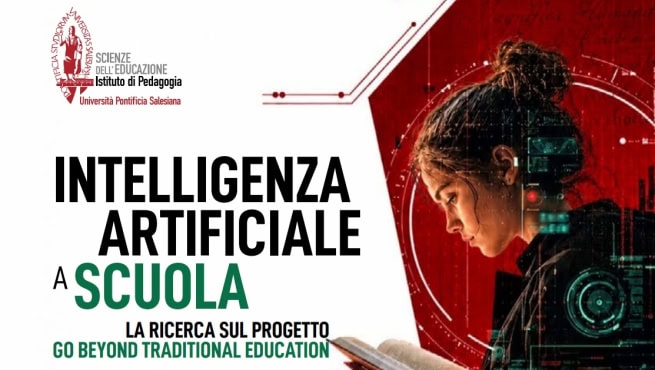
(Università Pontificia Salesiana, Roma) – On 5 November 2026, at the Pontifical Salesian University (UPS), a meeting dedicated to research on the national ‘Go Beyond Traditional Education’ project. The focus will be on the role of the teacher, cooperative learning and the educational relationship.
When a tool can produce a text, an explanation or the solution to an exercise in a matter of seconds, what does it mean to learn? The introduction of artificial intelligence into schools calls for reflection on the activities offered to pupils, the skills to be developed and how to foster the growth of independent thinking.
These questions will be the focus of the event ‘Artificial Intelligence in Schools: Research on the Go Beyond Traditional Education Project’, scheduled for 5 November 2026 at 3.00 pm in the Juan Vecchi Hall at the Pontifical Salesian University in Rome.
The event will bring together the experience of schools and academic reflection, addressing two key issues: how AI can support teachers’ methodological work and what role it can play in cooperative learning pathways.
The ‘Go Beyond Traditional Education’ project is rooted in the Salesian educational tradition and offers a programme of training, experimentation and knowledge-sharing on the use of AI. The centrality of the individual and the quality of relationships form the pedagogical framework guiding innovation, whilst maintaining the link between digital activities and experiences in the school playground, through play and community life.
‘Go Beyond Traditional Education’ is a movement involving over 1,600 participating teachers in more than 50 Salesian schools and vocational training centres across Italy.
On a national scale the initiative involves a network of educational, academic and technological stakeholders, with scientific coordination provided by the UPS. Areas of focus include personalised learning, instructional design and the testing of assessment methods, accompanied by research and monitoring activities. The presentation of the national programme highlights precisely this formative dimension.
This perspective raises practical questions for teachers. How can one design a task that requires pupils to understand, argue and verify information? How can one make visible the process through which a pupil constructs an answer? And how can generative tools be used within a group, encouraging discussion and the participation of every pupil?
The event will provide an opportunity to examine technology from the perspective of schools’ needs: to support teachers in their choices and to guide pupils towards becoming individuals capable of understanding, collaborating and taking responsibility for their own thinking.
For further information on the event programme, please visit the university’s website.
Source: ANS – “Agenzia iNfo Salesiana”