



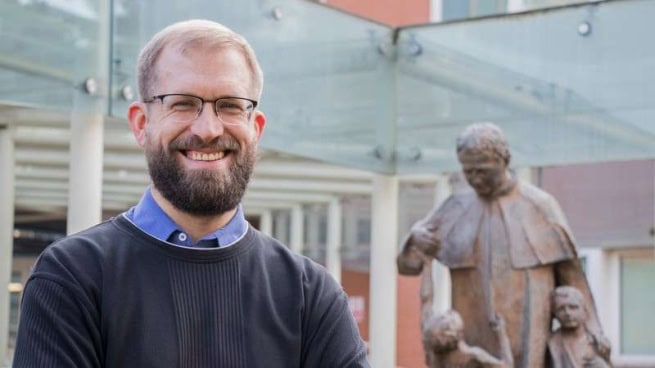
(ANS – Santiago) – Fr Michal Vojtáš, SDB, Director of the Don Bosco Study Centre at the Pontifical Salesian University (UPS) in Rome, reflects on the keys to educating a generation marked by loneliness and the digital age through presence, bonding and community.
The Salesian analyses the evolution and change in Salesian accompaniment, highlighting elements that remain unalterable pillars and those that require a new interpretation.
He emphasises that Don Bosco’s method retains an essential structure: ‘The beginning of accompaniment is from a moment of welcoming the young person in his concrete situation’, which, however, is not passive.
‘Don Bosco challenges the development of the young person with a combined welcome that produces an educational dynamic’. This process, he affirms, culminates in the creation of a life project, supported not only by an individual, but by the entire educational community.
‘The central and starting point is loving kindness, it is the acceptance of the young person as he/she is’. He underlines, moreover, that although the forms of dialogue change with the culture and the times, welcome is a human and universal gesture that remains.
New challenges
While in the past the main challenge was instruction, today the panorama is different. “Now there is the challenge of the loneliness of young people, the lack of orientation, the lack of meaning in life, as well as the challenges of the digital age.”
This new context requires adapting accompaniment strategies to respond to a fundamental need for connection.
Fr Vojtáš presents a balanced view of artificial intelligence, pointing out that the main danger is the replacement of human presence: “It is a risk when we, as educators, are not present and instead, artificial intelligence becomes the true companion.”
The sense of community
He recognises the enormous potential of technology if used correctly: “A positive vision of artificial intelligence is that we can better manage our use of time, approach new processes of learning, planning and, in short, have more time for real accompaniment on a human level.”
The solution to this crisis of loneliness and meaning experienced by young people is still to be found in community and personal encounters. His call to them is for courage and action: “Do not be afraid to enter into human relationships and ask for help.”
To educators he also recommends to “be available for listening, informal contact in the playground and openness to young people.”
It is precisely in this closeness that “a Salesian ideal of a life of community and relationships that enrich everyone is shared.”
Source: ANS – “Agenzia iNfo Salesiana”