



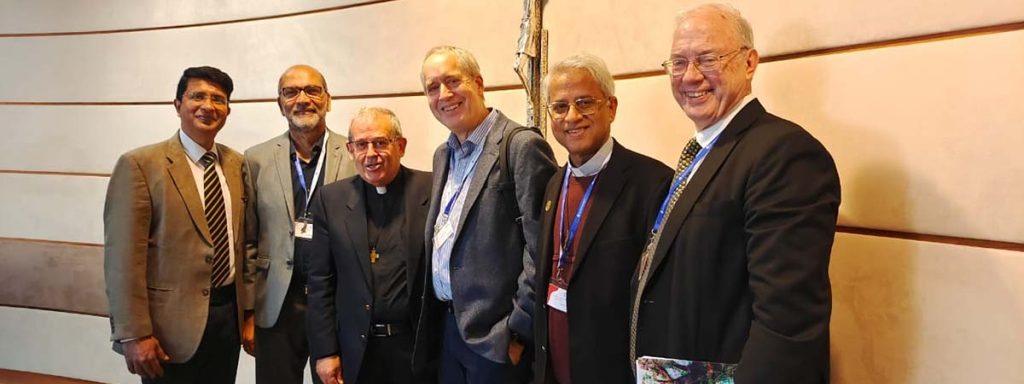
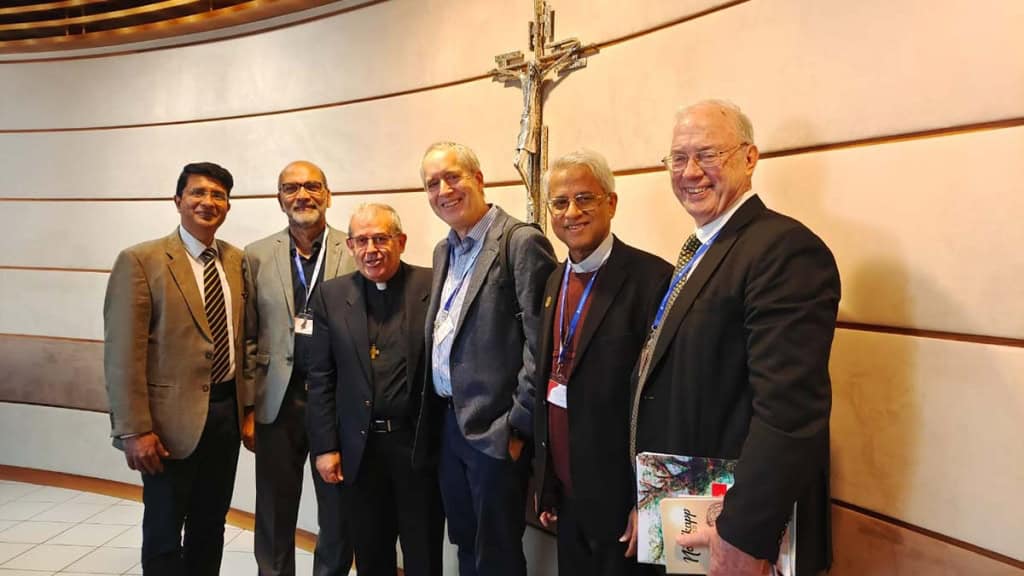
(ANS – Rome) – The Three-Day Conference on Salesian Facilitation came to a close on 30 October at the Salesian University, Rome, and concluded on 31st October 2025 at Sede Centrale Salesiana, Rome. It was preceded by the IUSTO one-day event on Salesian Facilitation in Higher Education on 23 October 2025 at Rebaudengo, Turin and marked a significant step in the effort to translate synodality—a way of walking together—into a concrete pedagogical and institutional methodology for higher education. Rooted in the Salesian tradition of participatory education, this initiative, as a pilot venture, seeks to enlarge an ongoing attempt to integrate listening, discernment, and co-responsibility into the very fabric of Salesian academic life.
Synodality as a Pedagogical Attitude
Rather than treating synodality as an external theme, IUSTO Pilot Project and the IUS Conference, Rome, 2025, embodied it as an educational process. The use of World Café and Open Space Technology sessions revealed a deliberate attempt to make dialogue and participation part of the learning method itself. These approaches encourage students, faculty, and administrators to engage as equal partners in discernment — echoing Don Bosco’s vision of education as a shared journey of reason, religion, and loving-kindness.
From Discussion to Discernment
The synodal process begun at IUSTO, Rebaudengo, Turin, the city of Salesian Origins, and continued into the IUS Conference 2025 in the Salesian University, Rome, the very heart of Salesian research, as noted by Fr Fabio Attard, the 11th Rector Major of the Salesians, in his opening remarks, moves beyond consultation to collective discernment. By structuring conversations around real issues — “the changing educational landscape” and “the challenges of formation in a pluralistic world” — participants from around the globe, were not only exchanging ideas but also learning how to listen with the heart and seek convergences inspired by the Spirit. This gradual move from debate to shared insight is the hallmark of a mature synodal practice.
Methodological Innovation: Action Research as Synodal Praxis
The formation of Action Research Teams marks a shift from reflection to action. It suggests that synodality, for the Salesians, is not merely a mode of governance but a method of continuous institutional renewal. Through collaborative inquiry, each team assumes responsibility for studying, experimenting, and reforming aspects of educational life — embodying the “walking together” in a practical, research-based way. In this sense, the synodal method is iterative, participatory, and transformative. The Rome participants were able to chart a course of action that they would like to see taken forward by the IUS Board as it gears towards the 9th IUS Assembly, due in Rome from 3 to 7 November 2026.
A Global Pedagogy in the Making
Though the Turin program was a pilot, and the Rome event a commencement, its implications extend across the network of Salesian Higher Education Institutions worldwide. The FAST (Facilitation Animation Salesian Team) methodology demonstrates that synodality can be cultivated through structured dialogue, participatory processes, and shared projects. This is intended to evolve into a global pedagogical framework for synodal formation in academia, integrating the spiritual, intellectual, and communal dimensions of Salesian education.
In essence, the IUSTO experiment replicated the following week in Rome as part of the Salesian University Institutions (IUS/ISHE) participation in the Jubilee of Education from 27-31 October 2025 shows that synodality in Salesian higher education is less a theory and more a way of proceeding: a style of forming persons and communities capable of discerning together. By intertwining Salesian pedagogy with participatory tools and action research. The Salesian Higher Education Network Global is giving concrete institutional expression to Pope Francis’ call for a synodal Church that listens, learns, and walks together.
George Thadathil, SDB
IUS/ISHE Global Coordinator