



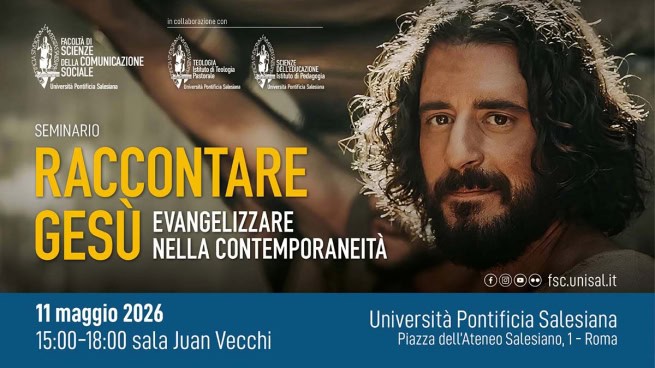
(Università Pontificia Salesiana, Roma) – In light of the international media phenomenon The Chosen – an interesting case study on the relationship between audiovisual series, the representation of the sacred and audience engagement – from May the Pontifical Salesian University (UPS) in Rome is launching a multidisciplinary research project aimed at providing an explanatory analysis of the phenomenon and opening up new avenues for research and further study.
In recent years, the relationship between audiovisual media and the religious dimension has taken on renewed prominence within academic discourse, in parallel with processes of digitisation, the growing fragmentation of audiences and the transformation of cultural consumption practices. In this context, television series emerge as a privileged space for symbolic re-elaboration, capable of capturing new forms of experiencing the sacred, no longer confined to traditional religious institutions but widespread within the media ecosystem.
“The Chosen” as a Contemporary Narrative Innovation
In this context, the series The Chosen emerges as a particularly significant case study. Created by Dallas Jenkins, the series stands out for its ability to combine a biblical narrative – centred on the figure of Jesus and his disciples – with the conventions of contemporary series, characterised by horizontal plot development, psychological exploration of characters and the construction of long-term narrative arcs. This approach allows content traditionally associated with the catechetical, or even liturgical, sphere to be transposed into an accessible, emotionally engaging and culturally situated narrative form.
It is within this perspective that a group of lecturers from the Pontifical Salesian University in Rome are undertaking a comprehensive and interdisciplinary research project based specifically on the series The Chosen.
The initiative, promoted by the Faculty of Social Communication Sciences, in collaboration with the Institute of Pastoral Theology of the Faculty of Theology and the Institute of Pedagogy of the Faculty of Educational Sciences, aims to systematically explore the textual, productive and receptive dimensions of the series, integrating approaches from media studies, the theology of communication and audience studies.
Launching the Project: A Key Academic Seminar
The research project begins with a study seminar to be held on Monday 11 May 2026 at 15:00 (UTC+2) in the Juan Vecchi hall at the Salesian University. The first part of the session will feature presentations by several experts who will discuss how the Christian community has narrated the figure and message of Jesus throughout history, with a particular focus on different historical periods and communicative and artistic languages. The second part of the seminar will feature a presentation by essayist Annunziata Antonazzo, author of an initial publication on Dallas Jenkins’ series: “We Are The Chosen. Jesus in an App” (published by Àncora).
Prof. Annalisa Guida, Lecturer in New Testament Exegesis at the Pontifical Theological Faculty of Southern Italy, “San Luigi” section in Naples, will present the literary and pictorial experience of the early centuries of Christianity; Prof. Giancarlo Olcuire, Lecturer in Art History and Graphic Design at the Faculty of Social Communication Sciences at UPS, will explore artistic and pictorial narrative from Humanism to the Renaissance; Prof. Fabio Pasqualetti, Dean of the Faculty of Social Communication Sciences at UPS, will focus on musical language, in particular Christian rock in the 20th century; Prof. Dario Edoardo Viganò, Professor of Cinema at Uninettuno University, will focus on audiovisual storytelling in cinema and television series.
Understanding Audience Engagement
And Prof. Maria Paola Piccini, lecturer in Social Research Methodology, will present the research project and the survey on how the public engages with the series “The Chosen”.
This seminar not only marks the launch of the research but also represents an opportunity for in-depth analysis and a first step towards building a network of collaborations capable of developing broader and comparative analyses over time. The programme includes, in fact, further events and opportunities for in-depth study, culminating in a study day and a publication, to coincide with the conclusion of the series The Chosen.
Source: Unisal