



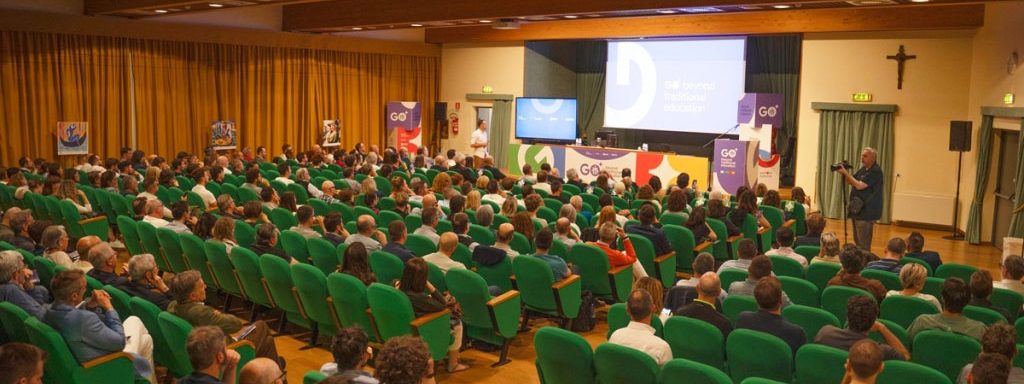
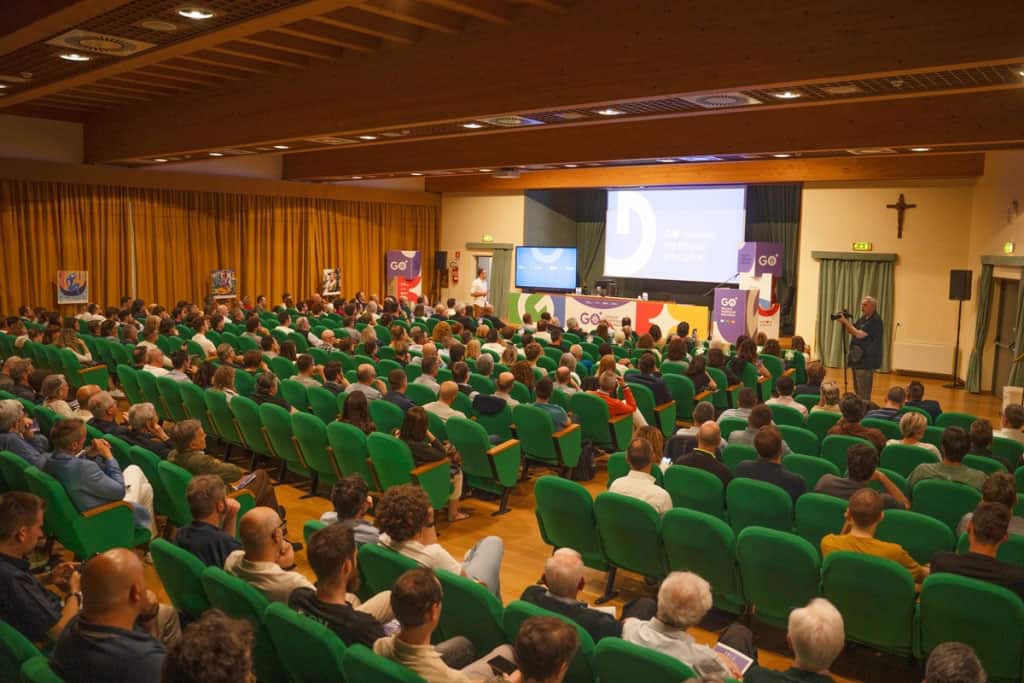
(Università Pontificia Salesiana, Roma) – In February 2026, fifteen engineers and researchers from Google around the world travelled to Venice Mestre, not to explain Artificial Intelligence (AI) to teachers at Salesian schools, but to hear how they were already using it in the classroom. At the end of May, Google will return to Italy, this time to Verona.
On the afternoon of Thursday 28 May, starting at 3 pm, the event “GO beyond traditional education” will take place at the San Zeno Salesian Institute in Verona. This is not a conference on the promises of AI, but an account of what has already happened in the classrooms. The international leadership of Google for Education will come to hear about the experiences of Italian Salesian schools: the first instance in Italy of AI being systematically introduced into the classroom across an entire network of schools.
In one year, the number of teachers involved has risen from 700 in the Triveneto region to over 1,600 across Italy. What matters are not the meetings or the guidelines, but the actual lessons, delivered every day by teachers in primary, secondary and formation schools.
The research evaluating them, coordinated by Fr Michal Vojtáš, SDB, for the Pontifical Salesian University, analysed 1,375 lessons actually delivered in the classroom and gathered feedback from 29,171 students.
The most significant finding is simple: after trying it out, 86% of teachers say they want to use AI on a permanent basis to support their teaching, and where one might usually fear a levelling-off, teachers report the opposite effect: a rise in content creativity of up to 40%. The benefits double when AI does not replace the lesson but complements new methods.
The feature that distinguishes the Salesian experience is not its scale, but rather a boundary. Whilst public debate is divided between technophobia and uncritical adoption, the Salesian experiment introduces the concept of “technology on a schedule”. It is not a ban, but a hierarchy of values: AI enhances learning, but stops when the purely educational relationship begins. It is not the machine that switches off, but the institution that reaffirms the primacy of the human face over the interface – a boundary that transforms ‘Gemini’ from a potential distraction into a managed resource.
The event on 28 May will be attended, on behalf of Google for Education, by Amanda Rosenburg (Staff User Experience Researcher, New York), Marco Berardinelli (Google for Education Italy) and Anna Artemyeva (HE Lead EMEA & APAC / Regional Lead [UK, Ireland, Italy, Central Asia]), alongside three regional councillors for education from Northern Italy: Valeria Mantovan (Veneto), Alessia Rosolen (Friuli-Venezia Giulia) and Simona Tironi (Lombardy). The project is thus entering its second year.
A school that creates thousands of lessons using AI, and decides where not to use it, is not chasing technology. It is managing it.
Source: ANS – “Agencia iNfo Salesiana”