



(Università Pontificia Salesiana, Rome) – A study day marking the 150th anniversary of the Pious Association of Salesian Cooperators was held at the Salesian Pontifical University (UPS) on November 24. The initiative was promoted by the Salesian Historical Institute, the Central Headquarters of the Salesians of Don Bosco, the Don Bosco Study Centre of the UPS, and the Faculty of Theology of the UPS. Its aim was to bring together the memory of the origins and a reflection on the relevance of the vocation of Salesian Cooperators today. It was also an opportunity to take stock of the Jubilee Year, following the World Congress in May and the meeting in Sacrofano last August.
Greetings: “A living and growing reality”
In his address, the Rector Major, Fr Fabio Attard, spoke of “a year of grateful remembrance, lived with our eyes turned towards the future”. He identified two tasks: revisiting the journey of the Pious Union over the past century and a half, and reflecting on the contribution of Salesian Cooperators to the educational and evangelizing mission of the Salesian Family. “Memory without this question risks becoming merely a celebration of the past. A question without memory would remain a projection towards a future without roots.”
Fr Attard recalled the World Congress in May and the regional meetings, which “have brought to light a living and growing reality”. He added that “the charism has also grown because so many lay people have made it their own”. He then looked ahead to next year, which will be dedicated to the 150th anniversary of the Preventive System, recalling the image of the jars at Cana from the Strenna: bringing “our water” so that the Lord may transform it into “good wine for the young”.
Mother Chiara Cazzuola, Superior General of the Institute of the Daughters of Mary Help of Christians, described Don Bosco as “a brilliant apostle of his time”. In her view, by involving lay people in full co-responsibility, he “anticipated much” of what the recent Synod is calling for. She stressed the importance of safeguarding and sharing documentation, and of experiencing memory as an “active process”, with “a passion for history, but even more so, a passion for the charism”.
Historical research: from 1876 to 2000
Professor Angelo Giuseppe Dibisceglia, lecturer in Church History at the Faculty of Theology of the UPS, presented the progress made on the research project Salesian Cooperators in History from 1876 to 2000, under the motto Vis unita fortior. The study is based on 431 texts held in the Don Bosco Library and 2,083 documentary references from the Central Salesian Archives. An initial contribution covering the period 1876–1877 has already been published in Ricerche Storiche Salesiane.
The account spans the terms of office of the Rectors Major from Fr Rua to Fr Vecchi. It covers the first International Congress in Bologna (1895), the two World Wars, the Second Vatican Council, and the 1986 Regulations of Apostolic Life. The guiding thread is a central question: who is the Salesian Cooperator throughout history? The answer traces the evolution of the figure from benefactor to lay person fully sharing responsibility for the mission. The volume is expected to be published in the coming months.
Don Bosco and his writings
Fr Aldo Giraudo, appointed Director of the Salesian Historical Institute on July 7, retraced the development of the idea of cooperation through Don Bosco’s writings between 1860 and 1883. The journey begins with the “external Salesians” included in the first Constitutions, but later removed at the request of the Holy See. It then moves through the “Christian Union” (1874) and the “Association of Good Works” (1875), culminating in the Regulations of 1876–1877.
What emerges is a figure in whom several dimensions coexist: the “religious in the world”, in the tradition of the Third Orders; the lay person committed to educational charity; the supporter of vocations; and the direct collaborator in the oratories. Added to these is the financial supporter, indispensable to the Salesian work. Fr Giraudo warned against reducing the Cooperator to a mere benefactor or simply a member of a Third Order.
The Cooperator today and witnesses to holiness
Borja Pérez, World Coordinator of the Association of Salesian Cooperators, presented the contemporary identity of the Cooperator in the light of the World Congress held in May 2026, outlining seven key points. He spoke of a lay vocation born from the heart of Don Bosco and renewed through synodality. He recalled the transition from “Salesian cooperator” to “Cooperator Salesian” in the Project of Apostolic Life. The Cooperator is a lay person rooted in baptism and called to be a Gospel leaven in temporal realities, because “the world is not an obstacle to holiness, but the place where it is fulfilled”. He also pointed out that vocation always comes before mission.
The final speaker, Lodovica Zanet, presented figures of holiness associated with the Salesian Cooperators. Among the names mentioned were Attilio Giordani, Vera Grita, Alexandrina Maria da Costa, Nino Baglieri, Matilde Salem, and Bartolomeo Blanco. She showed how people become Salesian Cooperators at different ages and through different life journeys. She concluded with the image of the “House of Don Bosco”, where everyone feels at home. The Salesians of Portugal had given Alexandrina Maria da Costa a fabric lily, to which she replied with a phrase recalled by the speaker: “I am no longer alone”.
A family gathering
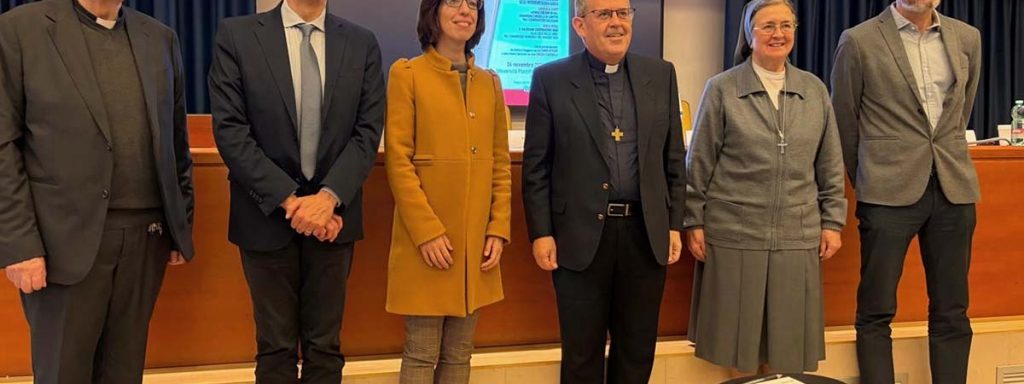
Between presentations, participants gathered for a group photograph with the Rector Major and the Superior General. Some attendees then shared brief reflections. One participant recalled that in Mexico and Chile the Salesian Cooperators arrived before the Salesians themselves.
Source: ANS – “Agenzia iNfo Salesiana”