



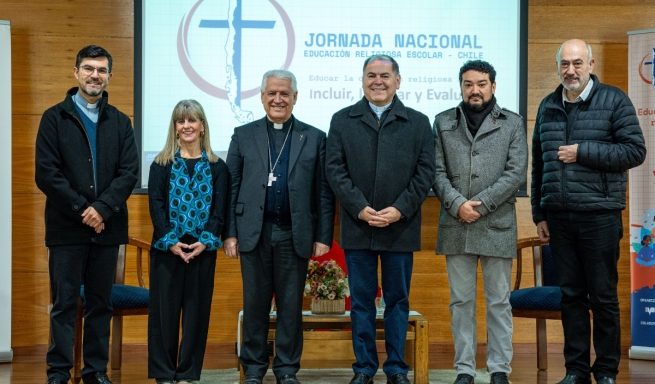
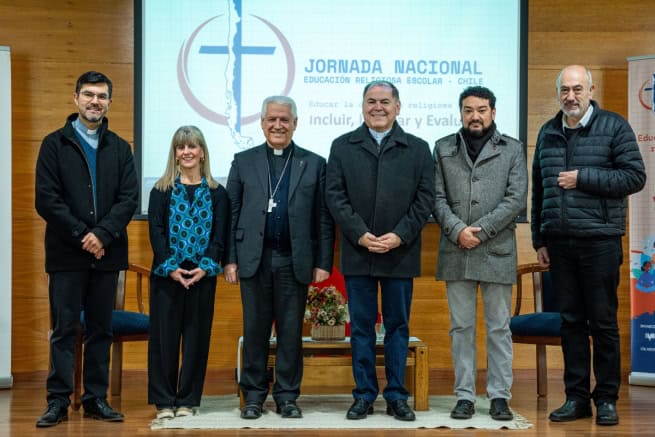
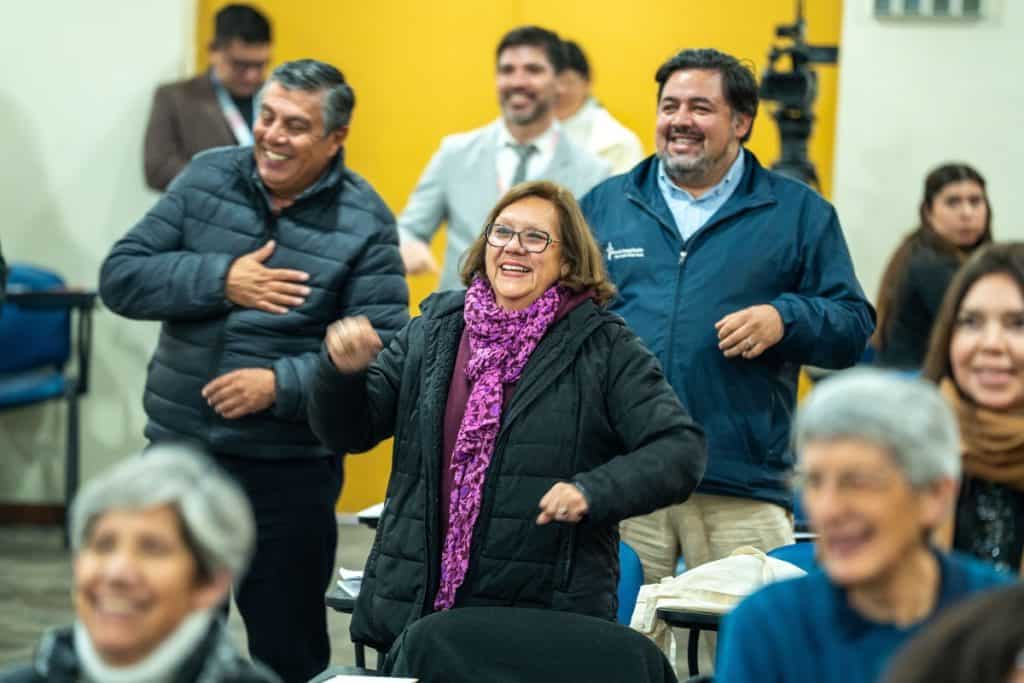
(Universidad Católica Silva Henríquez, Santiago de Chile) – Dozens of educators gathered on 2 June 2026 for the First National Day of Catholic Religious Education in Schools, a major event organised by the Salesian St Gabriel the Archangel Province, Chile (CIL), the Salesian publishing house EDEBÉ and the Salesian Catholic Silva Henríquez University, in collaboration with the Education Department of the Chilean Bishops’ Conference (Cech).
Under the motto “Educating in the religious dimension today: including, innovating and evaluating”, the day addressed the paradigm of Religious Education in Schools (EREC) and explored crucial issues for religious education teachers: innovation through Artificial Intelligence (AI), the integration of students with Special Educational Needs (SEN), and the challenge of assessment.
Fr Nelson Moreno, SDB, Grand Chancellor of the “Silva Henríquez” Catholic University and Provincial of the Salesians in Chile, warmly welcomed the attendees, emphasising the decisive contribution of EREC to the integral formation of children and young people.
“Catholic religious education in schools makes a decisive contribution to the integral formation of children and young people,” he stated, emphasising that the university, as a Salesian institution, fosters dialogue between faith, culture, education and social life.
He then recalled the figure of St John Bosco, “a great saint and educator, a natural formator of young people”, whose work began with a simple act of catechesis
“For us Salesians, religious education is part of our charismatic identity. Evangelising through education and educating through evangelisation is not merely an inspiring formula; it is a way of understanding our mission”, he concluded.
Bishop Alberto Lorenzelli, SDB, President of the Educational Area of the Cech, expressed his gratitude and joy for the initiative, and emphasised that the core curriculum for religious education is an enormously valuable contribution to Chilean schools and to the Church’s evangelising mission, ensuring up-to-date religious formation that is capable of engaging with students’ questions and concerns.
The prelate highlighted and emphasised the fundamental role of religious education teachers: “The Catholic religious education teacher is much more than a teacher. They are a witness to the Gospel, a teacher of humanity, a servant of the truth and a builder of hope. Their vocation demands professional competence and consistency of life. It is not enough to know; one must live. It is not enough to teach; one must love.”
The day then continued with an introductory presentation by Dr Solange Favereau, Director of the EREC-Cech Commission, entitled “The Relevance of Innovation, Inclusion and Evaluation in EREC”.
The speaker linked these three elements through the metaphor of the Road to Emmaus, emphasising that EREC accompanies the great human questions in the light of the encounter with Christ.
The speaker emphasised that Christian inclusion recognises the dignity of every person and their legitimate questions, and that innovation in EREC does not seek entertainment or follow technological trends, but aims to engage the student on an intellectual and existential level.
With regard to AI, she urged teachers to carefully evaluate its use, reinvesting the time saved in accompanying processes and building relationships, always keeping the person at the centre.
Roberto Pavez, Director of the Education Department at Cech, presented the findings of a study on “The paradigms of EREC in Chile”. He offered a historical overview of the curriculum renewal since 2015, culminating in the approval of the EREC 2020 curriculum framework.
He emphasised that the current proposal is distinguished by its anthropological approach, unlike the 2005 programme, which was predominantly catechetical. He highlighted the choice of a Christian anthropology, the emphasis on integral formation and the spiritual development of the human person, structured around three programme axes: Nature and Culture, Person and Society, and Religion and Spirituality.
He emphasised that EREC 2020, recognised by the Ministry of Education, is compulsory and aims for a more human and integrated education, addressing students’ major existential questions.
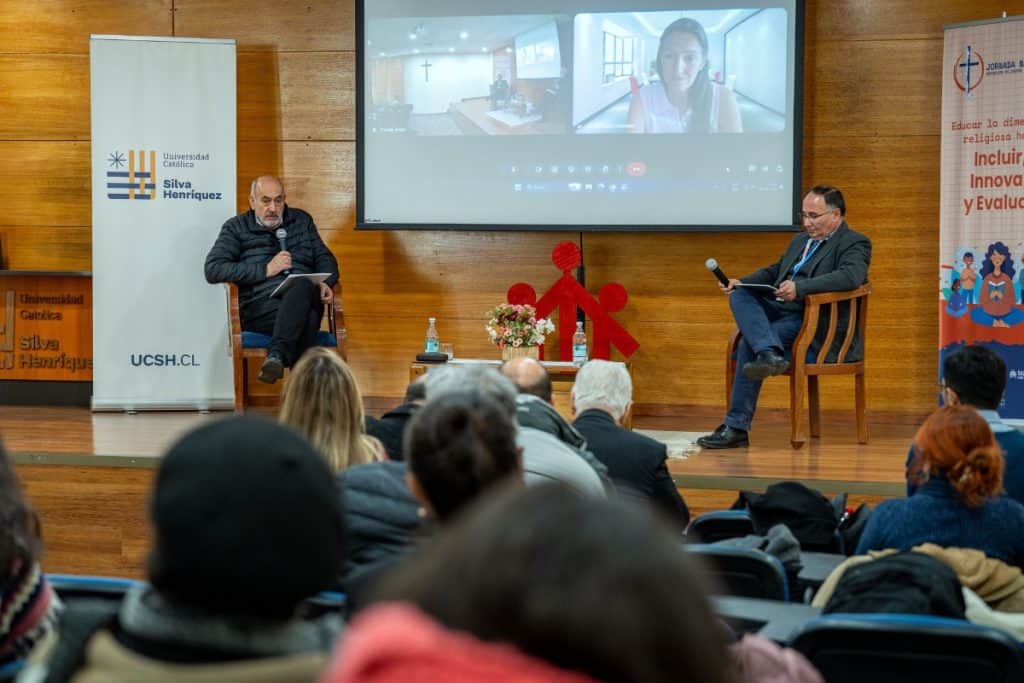
The day’s programme also included a debate on EREC in Chile and Europe, featuring Gloria Díaz Leonart, coordinator of the Religion Department at the Spanish publishing house Edebé; and a session dedicated to special educational needs and inclusion within EREC, presented by Magali Espech, Head of the Degree Course in Special Education at UCSH.
A workshop on Formative Assessment and Assessment Tools was also held during the morning, led by Dr Sandra Zepeda of the University of Chile and Cristina Campos, Educational Consultant for the Salesian Institute Network.
The afternoon was devoted to a practical workshop on AI and the EREC, exploring how to plan teaching units and design lessons using this technology, led by Freddy Araya, coordinator of the Evangelisation Department of the Salesian Schools Network, and Manuel Venegas, coordinator of the Salesian Youth Movement of the Salesian Schools Network
Revisa la A recording of the event is available online
Source: Boletín Salesiano de Chile ; ANS – “Agencia iNfo Salesiana”