



(ANS – Madrid) – With his arrival in Madrid on 6 June 2026, Pope Leo XIV began his fourth international apostolic journey, a visit taking him through various regions of Spain under the motto “Alzad la mirada” (“Lift up your gaze”). The first two days featured meetings with the country’s institutions, engagement with social bodies, and events dedicated to young people and the world of culture. The Corpus Christi procession led by the Pontiff through the streets of the Spanish capital made a great impression, providing an opportunity to return to the truest meaning of Christian faith and spirituality.
On the morning of Saturday 6 June, the Pontiff departed from Rome for Madrid. Upon arrival at Adolfo Suárez Madrid-Barajas Airport, he was welcomed by civil and religious authorities before proceeding to the Royal Palace.
Here the official welcome ceremony took place, followed by a courtesy visit to the Spanish monarchs, King Felipe VI and Queen Letizia. Subsequently, Pope Leo XIV met with the authorities, representatives of civil society and the diplomatic corps. In his address, he expressed his gratitude for the invitation and recalled the nation’s deep Christian roots. The Pope recalled that Spain is a land which “for almost two millennia has received the Word of the Gospel” and emphasised how the country’s spiritual and cultural heritage still represents a resource for facing the challenges of the present day. He then explained the profound meaning of his journey, significant from both a religious and a civil perspective: “I come among you to confirm, encourage and inspire a renewed fidelity of believers to the Gospel and a deeper reconciliation and cooperation among the diverse communities of this nation.”
During his address, he also highlighted the value of human dignity, solidarity and the pursuit of the common good, emphasising the need to strengthen social bonds in a time marked by tensions and polarisation. The call was to foster a culture of encounter capable of promoting dialogue and collaboration among the various components of society. “On closer inspection, the message of peace, which in these times, unfortunately, strikes some as naive and others as provocative, finds a welcome among those who do not shut themselves off in preconceived ideologies but are open to the truth,” observed the Holy Father.
In the afternoon, the visit took on a more pastoral and social character. Pope Leo XIV visited the “Cedia 24 Horas” project a centre for hospitality and solidarity that welcomes vulnerable and homeless people. After listening to the testimonies of those receiving support and the volunteers, the Pontiff urged Christians not to allow themselves to be “infected by attitudes marked by worldly ideologies or political and economic orientations that lead to unjust generalisations and misleading conclusions”, recalling that commitment to one’s neighbour is not “the obsession of a few”, but “the burning heart of the Church’s mission.”
The first day concluded with a large prayer vigil with young people in the Plaza de Lima, together with some 600,000 young men and women. During the vigil, the Pope answered questions posed by young people, recalling his years as a missionary in Peru, where he witnessed a faith “marked by many difficulties but full of hope.”
And he urged the young people to look to the future with hope, to live their faith as a concrete experience of encounter with Christ and with others, to be “human”, “trustworthy faces” and not mere “appearances” for their peers, and to be able to find joy in life without waiting for wealth, pleasure or power.
“Jesus’ disciples are always of their time, but never prisoners of the passing of time,” he added. “In Christ we are free! (…) We are free from fads, because we are disciples of the truth; we are open to the future, because we know that death does not await us.”
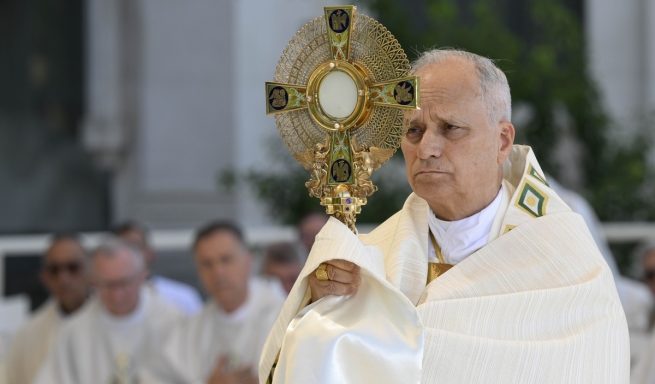
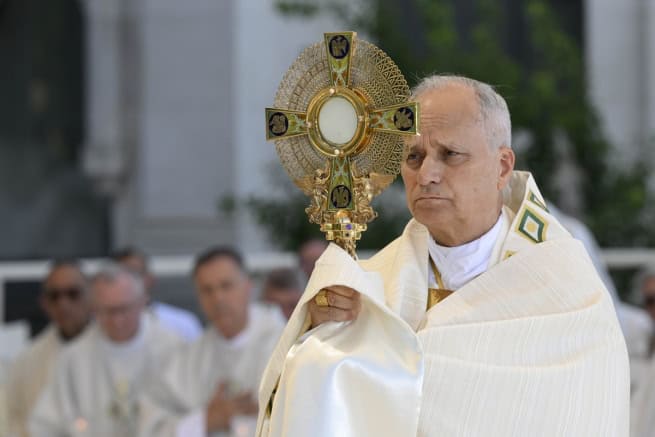
The second day of the trip, 7 June, saw further important moments of encounter and reflection. First and foremost, the solemn Eucharistic celebration in Plaza de Cibeles, attended by some 1.2 million faithful, followed by the Eucharistic procession with the Blessed Sacrament.
“This awareness of the Lord’s presence in the Eucharistic Bread is deeply rooted in the faith and the history of your people. Here in Madrid, as in many other parts of Spain, Corpus Christi is more than just another celebration on the liturgical calendar. It is a way of returning to the heart of the faith to renew our love and fidelity to God,” explained Leo XIV in his homily.
However, he did not stop merely at the devotional or traditional aspects of the feast, but delved deeper, recalling: the religiosity which has shaped and defined this country for centuries is not a museum of the past to be visited, but a school of faith from which to draw even today: A school that teaches us to kneel before God and before our neighbor, because no one can kneel before the Lord and despise their brother; (…) A school from which we learn that God is a real presence and that we too are called to be present in the realities and challenges of society, not shying away, but personally committing ourselves to the building of the common good.”
In the afternoon, there was still time for the meeting entitled “Weaving networks with the worlds of culture, art, economics and sport”, held at the Movistar Arena. The event was attended by around 15,000 people from various professional and cultural backgrounds. The key themes of the speeches were the social dialogue between humanity and the Church, and the dignity of the human person, in the midst of the epochal change brought about by new technologies and artificial intelligence.
In his address, the Pope emphasised the need to build relationships and collaboration between worlds often perceived as separate. Instead, in his view, culture, creativity, economic activity and sport were presented as spaces in which to promote human dignity, social responsibility and fraternity. And the image of “weaving networks” was used to indicate the building of bonds capable of generating participation and hope.
Source: ANS – “Agência iNfo Salesiana”